7 Signs You Need an Astrology Reading


Astrology readings are most useful when you need context, timing, and a clearer frame for a real-life decision, not when you want a single dramatic prediction. A good reading should connect your birth chart to specific factors like the Ascendant, houses, dashas, transits, and nakshatras.
TL;DR
- An astrology reading is most worth getting when you are at a transition point and need chart-based timing, not just a generic horoscope.
- Exact birth details matter because the Ascendant is time-sensitive and can shift about one degree every four minutes, which can change houses and interpretation.
- The strongest signs you need a reading include repeated confusion around career, relationships, relocation, timing, and major life cycles like a dasha change or Saturn transit.
- A useful Vedic astrology reading should explain planets, houses, nakshatras, yogas, and dashas together, while separating calculation facts from interpretation.
- If your birth time is uncertain, then use a Moon sign, nakshatra, or broader transit reading first, and avoid overconfident claims about precise houses.
- Good astrology can support reflection and planning, but it should not replace judgment. Pew found 30% of U.S. adults consult astrology, tarot, or fortune tellers at least yearly, while only 1% rely a lot on them for major life decisions.
That distinction matters because astrology can feel deeply personal even when the language is broad. The most useful readings reduce that problem by grounding interpretation in exact chart data, transparent method, and practical next steps.
When is an astrology reading actually useful?
An astrology reading is most useful when a real question meets a real timing pattern. In Vedic astrology, Saturn, Jupiter, and Mahadasha changes often give the chart enough structure to discuss decisions clearly.
If you are only looking for reassurance, a reading may feel good but stay vague. If you are asking why a period feels heavy, why a career path keeps stalling, or why a relationship pattern repeats, then chart analysis becomes more practical. In Jyotish, that means looking at the Lagna or Ascendant, the Moon, planetary dignity, house lords, current dasha, and live transits together.
A common misconception is that astrology is only about personality. In practice, many people use readings for timing windows, pressure points, and strengths they can act on. That makes it closer to pattern interpretation than fortune telling.
Why do exact birth details matter more than most people think?
Exact birth data matters because the Ascendant and house structure can change fast. Astrodienst notes the Ascendant shifts about one degree every four minutes, which can alter house placement and chart emphasis.
In Vedic astrology, the birth time affects the Lagna, divisional charts, and sometimes the nakshatra boundaries involved in dasha timing. Since each zodiac sign spans 30 degrees, even a small time error can move the rising degree enough to change where planets fall by house. If your chart says Mars is in the 10th house instead of the 11th, the reading can shift from career pressure to networks and gains.
"StarYaar uses Swiss Ephemeris accuracy with sub-arc-second precision, a meaningful detail when birth time is tight and the Ascendant changes quickly."
Birth place matters too, because local coordinates affect the house framework. Pro tip: if your recorded birth time is uncertain, say so upfront. A careful reader will usually widen the interpretation, check Moon-based patterns, or use rectification logic instead of pretending the chart is exact.
What are the 7 signs you need an astrology reading?
The clearest signs are repeated patterns, timing confusion, and transition stress. When Venus, Saturn, Rahu, or a dasha lord keeps showing up in the same life area, a proper reading can turn scattered feelings into a structured question.
After you notice the same issue more than once, it helps to map it against your chart instead of relying on a daily horoscopes alone.
- You are at a life crossroads: career change, marriage, breakup, relocation, or a business decision needs timing context.
- The same pattern keeps repeating: similar partners, job conflicts, money leaks, or family tension keep cycling back.
- You feel “off” without a clear reason: a Saturn transit, Sade Sati, or a Mahadasha shift may describe the pressure better than mood labels alone.
- Your daily horoscopes feel too generic: you want houses, nakshatras, yogas, and dasha periods, not broad sign language.
- Your birth chart raises a specific concern: Manglik, Kaal Sarp, debilitated planets, or a tough 8th-house pattern needs context, not fear.
- You need better timing: Muhurat, Panchang, transit windows, and planetary periods can help sequence actions.
- You want a second layer after self-study: tools like StarYaar, Astro.com, or a traditional astrologer can help test what you already suspect in your chart.
The key is not drama. It is usefulness. If the reading helps you ask better questions and choose better timing, it has done its job.
How is a Vedic astrology reading different from a sun sign horoscope?
A Vedic astrology reading is chart-specific, while a sun sign horoscope is category-level. One uses your birth time, place, and sidereal framework; the other usually speaks to millions of people born under one sign.
Sun sign astrology often starts with the solar position only. Vedic astrology usually starts with the Lagna, Moon sign, nakshatra, planetary house rulership, yogas, and dasha sequence. Many Vedic practitioners also use a specific ayanamsha, often Lahiri, and may consult divisional charts like D9 for marriage themes or D10 for career.
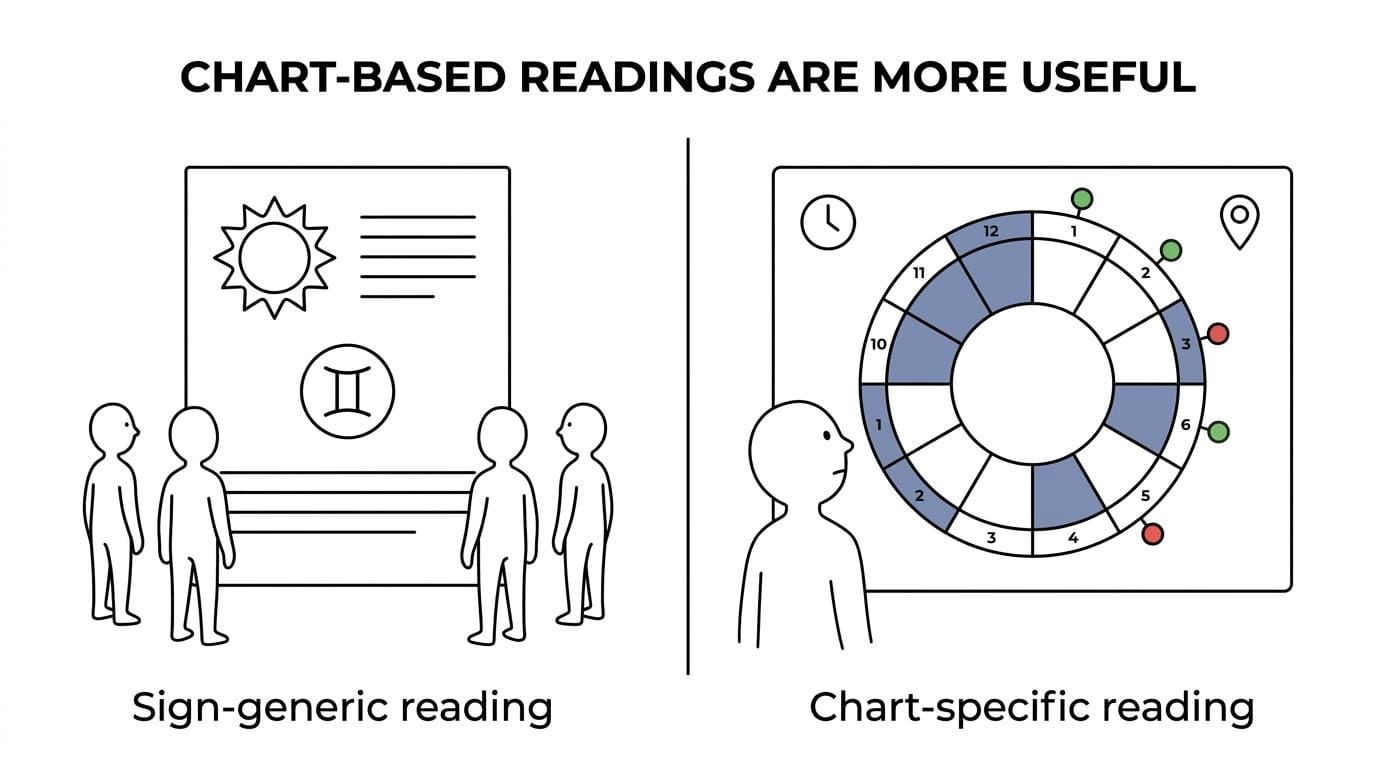
Side-by-side comparison of a Vedic astrology reading and a sun sign horoscope, showing exact birth data, houses, dashas, and timing on one side versus broad sign-based guidance on the other.
That difference matters because chart reading is not just “What sign are you?” It is “Which planet rules your 10th house, where is it placed, what is its dignity, and what period is active now?” If you want timing and specificity, the second format is usually more useful.
"StarYaar provides divisional charts from D1 to D60, which matters when a reading moves beyond a basic birth chart."
How do you prepare for an astrology reading step by step?
Preparation improves accuracy because your question shapes the interpretation. A chart can show many themes, but a focused reading will prioritize the ones that matter now.
Before the session, gather your data and define your question. That simple step prevents the reading from becoming a vague personality recap.
- Confirm your birth date, exact time, and birthplace from the most reliable source available.
- Write one primary question and one secondary question. Good examples are career timing, relationship patterns, relocation, or finances.
- Note recent events by month and year, especially breakups, job changes, health shifts, and moves.
- Decide your tolerance for uncertainty. If your birth time is approximate, say that clearly.
- Ask which method is being used, including zodiac type, ayanamsha, and whether the reading emphasizes dashas, transits, or divisional charts.
A pro tip here is simple: avoid asking ten unrelated questions. One focused question usually gives a better reading than a scattered session.
How do dashas, transits, and houses work together in timing?
Dashas set the main period, transits trigger the moment, and houses show the life area. In Vedic practice, a Jupiter transit means one thing in a Venus Mahadasha and something else in a Saturn Mahadasha.
Many people treat transits as the whole story. That is a common mistake. A transit can describe external pressure, but dashas often describe why that pressure lands so strongly for you. Houses then translate the theme into concrete areas like work, marriage, children, debts, or travel.
- Start with the active Mahadasha and Antardasha to identify the main period lord.
- Check the natal condition of those planets, including sign, house, aspects, conjunctions, and yogas.
- Layer current transits of Saturn, Jupiter, Rahu, and Ketu onto those natal promises.
- Read the affected houses, especially the houses occupied, ruled, and aspected by the period lords.
- Narrow the interpretation into likely themes, then test them against recent events.
If the dasha lord is strong and a supportive transit activates the 10th house, then career movement is more plausible. If the same transit hits during a difficult 8th-house period, then the tone may shift toward pressure, repair, or transformation.
How can you check whether a reading is specific or just generic?
Specific readings name chart factors, while generic readings rely on broad statements. The Barnum effect, defined by the APA Dictionary of Psychology, is the tendency to accept vague descriptions as uniquely personal.
That does not mean all astrology is empty. It means you should listen for evidence. A useful reading explains why a claim is being made, using placements, houses, nakshatras, yogas, or dashas. A weak reading stays at the level of “you are sensitive but strong.”
Use this quick test when you listen or read:
- Look for named chart factors: Moon in a nakshatra, Saturn in a house, or a Venus Mahadasha.
- Check whether timing is anchored: month ranges, transit windows, or dasha periods.
- Ask whether the interpretation changes if the birth time changes. If not, the reading may be too broad.
- Notice whether trade-offs are explained. Strong Venus can help relationships and spending, not just one side.
- Separate fact from interpretation: calculation is one layer, meaning is another.
Pew found that 20% of U.S. adults use astrology, tarot, or fortune tellers mostly for fun, while 10% say these practices give helpful insights. That split is useful. If you want insight, demand more than pleasing language.
What should a trustworthy astrology reading include?
A trustworthy reading includes clear method, chart logic, and practical limits. Brihat Parashara Hora Shastra and Phaladeepika are common reference points in Jyotish, but modern tools still need transparent calculation settings.
The strongest readings usually include these elements after the core chart is calculated:
- Calculation method: sidereal zodiac, ayanamsha used, and a reliable ephemeris engine
- Chart structure: planets, houses, signs, nakshatras, yogas, and divisional charts where relevant
- Timing logic: Mahadasha, Antardasha, and major transits mapped to real dates or windows
- Interpretation limits: what is stable in the chart versus what is conditional or uncertain
- Practical output: strengths, risks, useful timing, and actions that do not depend on fear
A misconception worth clearing up is that a trustworthy reading must sound extreme to sound accurate. Usually the opposite is true. Careful readers speak in probabilities, conditions, and ranges.
"StarYaar offers 3 complimentary AI readings, which is useful when you want to compare a natal reading with a transit or dasha-focused interpretation."
Which matters more, the astrologer, the software, or the birth data?
Birth data matters first, software matters second, and interpretation matters third. A skilled astrologer and a strong tool like Swiss Ephemeris both fail if the birth time is wrong.
Think of it as a chain. The data gives the chart. The calculation engine turns the data into placements. The astrologer, or AI system, interprets those placements using a framework. If the first link is weak, the whole reading gets unstable. If the software is careless, divisional charts and house placements can drift. If the interpretation is sloppy, even accurate calculations sound generic.
Quote card with the line: Reliable astrology is not just intuition. It is data plus method plus judgment.
That is why modern platforms and traditional readers should both be judged on method transparency. Ask what zodiac is used, what ayanamsha is used, whether the chart supports D1 through divisional analysis, and how the reader handles uncertainty. Reliable astrology is not just intuition. It is data plus method plus judgment.
Can astrology help with major life decisions without replacing judgment?
Yes, astrology can support decisions, but it should not make them for you. Pew found only 1% of U.S. adults rely a lot on astrology, tarot, or fortune tellers for major life decisions.
That number is a healthy reminder. A reading can help you frame questions about timing, compatibility, career cycles, or pressure periods. It can also help you notice strengths that are easy to ignore, like a disciplined Saturn, a persuasive Mercury, or a protective Jupiter. Still, it should sit next to practical evidence, family realities, finances, and professional advice.
If astrology says a period favors relocation, then treat that as a planning signal, not a command. If the chart shows strain in a relationship period, then use that as a prompt for clearer communication, not fatalism. The best readings help you respond better. They do not take your agency away.