Best Rising Sign Calculator Tools


A reliable rising sign calculator should do more than return a zodiac label. It should compute the Ascendant, also called the Lagna in Vedic astrology, from your exact birth date, birth time, and birthplace because that point changes quickly and sets the structure of the whole chart.
TL;DR: SummaryThe best rising sign calculator tools ask for birth date, exact birth time, and birth city, then show the Ascendant or Lagna with degree and house context, not just a sign name.A rising sign changes about every 2 hours on average, but sources like Cafe Astrology note it can change in about 30 minutes or nearly 3 hours depending on latitude, so time accuracy matters more than fancy design.For Vedic astrology, choose a calculator that supports sidereal settings like Lahiri Ayanamsa, since your Lagna may differ from a tropical Western Ascendant.Higher-quality tools are usually built on solid astronomical engines such as Swiss Ephemeris and handle time zones, daylight saving time, house cusps, and latitude correctly.If two calculators disagree, check birth time rounding, ayanamsha, house system, and birthplace coordinates before trusting the interpretation.
If your goal is to find the best rising sign calculator tool, the real test is simple: does it calculate the Ascendant precisely enough to support the rest of the chart? That means looking at the degree, houses, zodiac system, and calculation method, not only the sign itself.
What is a rising sign calculator?
A rising sign calculator computes the Ascendant or Lagna from your birth date, birth time, and birthplace. Tools using Swiss Ephemeris or similar engines are usually more dependable because they also account for time zones, latitude, and house cusps.
Astronomically, the Ascendant is the zodiac degree rising on the eastern horizon at the moment of birth. In astrology, that point becomes the starting reference for the 1st house and helps determine the layout of all 12 houses. In Vedic astrology, the Lagna shapes how planets, yogas, and dashas are interpreted through the house system.
A common misconception is that the Ascendant is just another personality label like a Sun sign. It is more structural than that. If the Lagna changes, the house placement of planets can change too, which can alter readings about career, relationships, health, and timing.
What information do you need for an accurate rising sign result?
You need three core inputs: birth date, exact birth time, and birthplace. Cafe Astrology and StarYaar both stress this because the Ascendant is one of the most time-sensitive points in the chart.
A strong calculator should request more than a day and city search. At minimum, it should correctly convert local birth time into the astronomical framework used for the chart. If the time is off by even 10 to 15 minutes near a sign boundary, the Ascendant can flip.
- Birth date: establishes the planetary positions for that calendar day
- Exact birth time: identifies the degree rising on the eastern horizon
- Birthplace: determines latitude, longitude, and local time zone handling
- Chart settings: tropical or sidereal zodiac, plus house system where relevant
"StarYaar asks for date of birth, time of birth, and birth city because the Lagna can change in about 2 hours."
Pro tip: do not assume a rounded hospital memory like “around 6 a.m.” is good enough. If your chart is close to a rising-sign change, that estimate can produce the wrong Lagna and shift several house placements.
What are the best rising sign calculator tools?
The best rising sign calculator tools are the ones that show the Ascendant with degree, chart context, and clear settings. StarYaar and Cafe Astrology stand out for different reasons, while Swiss-Ephemeris-based platforms set the technical benchmark.
If you are comparing options, look for tools that do full-chart math rather than simplified birthday widgets. These are the most useful categories to compare:
- StarYaar: Best if you want a Vedic Lagna calculator with birth-chart context, Lahiri-style sidereal use cases, Swiss Ephemeris accuracy, and follow-on tools like dasha timeline, yogas, and divisional charts.
- Cafe Astrology: Good for quick Ascendant checks and plain-language education, especially if you want a clear explanation of why birth time and latitude matter.
- Astro.com: A strong benchmark for users who want technical chart controls and Swiss Ephemeris-based infrastructure in a broader astrology environment.
- Astro-Seek: Useful for people who like comparing settings manually and reviewing degrees, houses, and chart variants.
- Any full-data calculator: Better than a birthday-only tool if it asks for exact time and place and shows the Ascendant degree with house structure.
A practical rule helps here: if a tool only returns “You are Scorpio rising” and nothing else, it is probably fine for curiosity but weak for serious interpretation. The better tools make the calculation transparent.
How do Vedic and Western rising sign calculators differ?
Vedic and Western rising sign calculators use the same birth astronomy but different zodiac frameworks. Vedic tools usually apply a sidereal zodiac, often Lahiri Ayanamsa, while Western tools usually use the tropical zodiac.
This means the same moment of birth can produce a different sign label even though the underlying eastern horizon point is the same. In practice, a person shown as Aries rising in a tropical chart might appear as Pisces Lagna in a sidereal chart, depending on the degree.
The distinction matters because the interpretive system changes with it. Western readings often center on psyche and temperament. Vedic readings connect the Lagna to houses, planetary lordships, nakshatras, yogas, and timing systems like Vimshottari Dasha. Common mistake: people compare two calculators without noticing one is tropical and the other is sidereal.
How can you calculate your Ascendant step by step?
You can calculate your Ascendant manually only if you have precise birth data and a proper ephemeris workflow. For most people, a calculator using Swiss Ephemeris is the practical way to do it correctly.
The core logic is straightforward even when the math is not. The software converts your birth time to the right astronomical time standard, maps your birthplace coordinates, then finds the zodiac degree rising on the eastern horizon.
- Enter your birth date, exact birth time, and birth city.
- Choose the zodiac framework: sidereal for Vedic or tropical for most Western tools.
- Let the calculator compute the Ascendant degree and the 12-house layout.
- Confirm the output includes the sign, degree, and chart context, not only a one-line label.
If you want to sanity-check the result, compare it with two calculators using the same zodiac setting. If both match on sign and degree range, your input is probably consistent.
How do latitude and polar locations affect the Ascendant?
Latitude materially changes how fast signs rise, and Swiss Ephemeris documentation shows why edge cases matter. Cafe Astrology notes a sign can ascend in about 30 minutes or nearly 3 hours depending on location.
Many users hear that rising signs change every 2 hours and treat that as a fixed rule. It is only an average. Closer to the equator, sign durations can feel more even. Farther from the equator, some signs rise quickly and others more slowly, which makes exact location more important.
Swiss Ephemeris also documents special handling beyond the polar circles. In some conditions, the software may switch house calculation behavior and return a warning. At the geographic poles, the Ascendant is reported as 0 Aries or 0 Libra.
"StarYaar defines the Lagna as the sign rising on the eastern horizon at the exact time and place of birth, which is why location accuracy matters."
This is one reason stronger calculators show house context. The Ascendant is not floating by itself. It is tied to how the local horizon intersects the zodiac and how house cusps are computed from that geometry.
How can you verify whether a rising sign calculator is accurate?
You can verify a rising sign calculator by checking its inputs, settings, and output detail. StarYaar and Swiss-Ephemeris-based tools are more trustworthy when they show degree-level results instead of only a sign name.
Accuracy checks are simple once you know what to inspect. You do not need to recalculate the sky by hand, but you should confirm that the tool is transparent.
- Check that the tool asks for date, exact time, and birthplace.
- Confirm the output shows the Ascendant degree and ideally the house layout.
- Match the zodiac setting: sidereal with Lahiri Ayanamsa for Vedic, or tropical for Western.
- Compare the same birth data in a second calculator to catch time-zone or daylight-saving mistakes.
If two tools disagree by a full sign, the problem is usually not your destiny. It is usually a settings mismatch, a rounded birth time, or a birthplace lookup issue.
Which matters more: exact birth time or advanced chart features?
Exact birth time matters more than advanced features. A plain calculator with correct time-zone math beats a polished app with vague inputs every time.
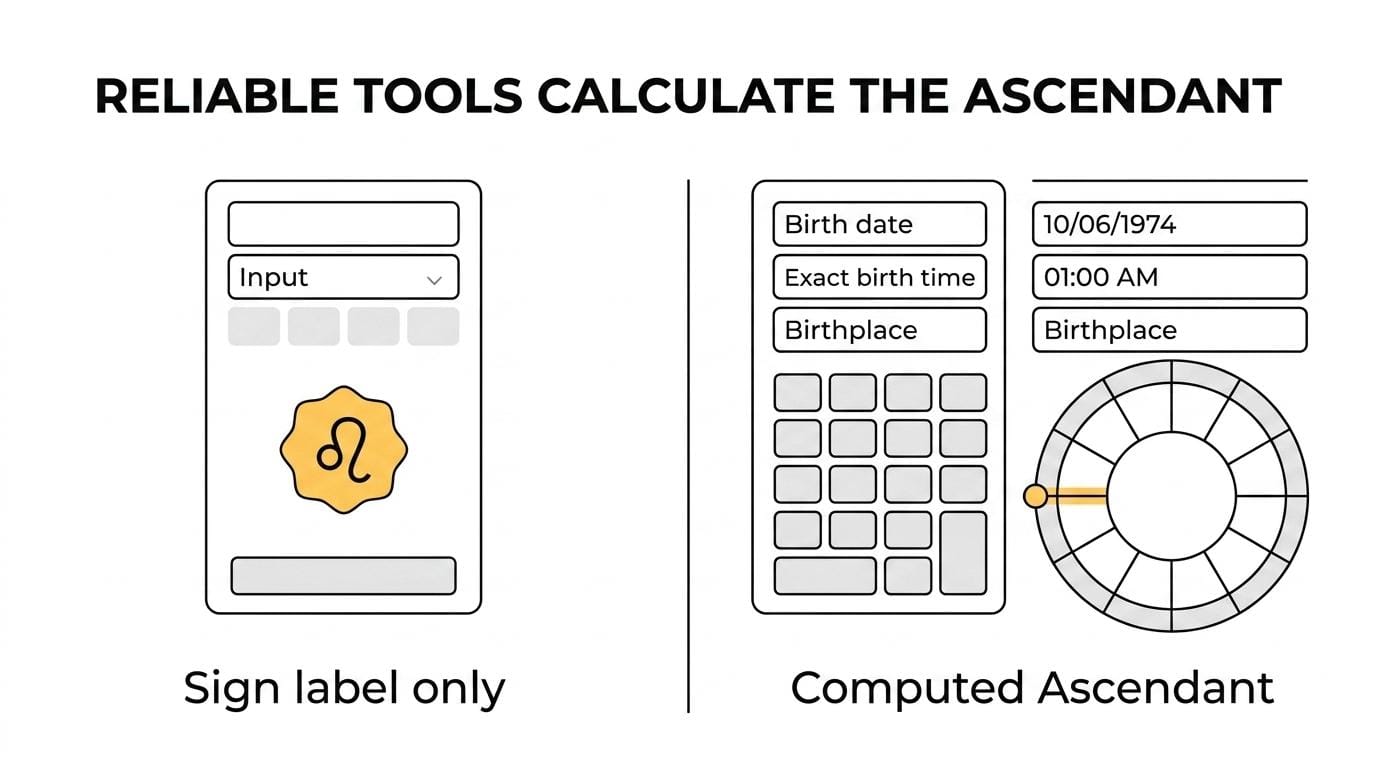
Side-by-side comparison of a precise rising sign calculator showing birth time, birthplace, Ascendant degree, and houses versus a basic tool showing only a rising sign label.
This is the easiest buying decision in the category. If a tool offers AI summaries, daily horoscopes, matching, PDFs, and nice visuals, those are useful extras. They do not rescue a weak Ascendant calculation. Since the Lagna determines the 1st house reference, an incorrect time can misplace houses and change how planets are read across the chart.
A good rule is: first trust the astronomical engine, then the interpretation layer. Common mistake: users pick the prettiest interface and overlook whether the tool supports exact birthplace resolution, ayanamsha selection, or house-cusp output.
Why do some calculators show different rising signs for the same birth data?
Different rising sign results usually come from different zodiac systems, time handling, or location logic. Cafe Astrology, Swiss Ephemeris standards, and Vedic platforms like StarYaar all point back to settings and input precision.
The most common source of mismatch is tropical versus sidereal. The next most common issues are daylight saving time, incorrect birthplace selection, and times entered in 12-hour format without AM or PM clarity. A sign boundary can be crossed surprisingly fast.
There is also a deeper technical layer. Swiss Ephemeris notes that house systems are not identical, and the Ascendant is not always identical to the 1st cusp under every framework. If one calculator hides its house system while another exposes it, the chart may look inconsistent even when the core astronomy is close.
How should you read your rising sign with houses, nakshatras, and dashas?
You should read the rising sign as the chart’s structural anchor, not as a standalone label. In Vedic astrology, the Lagna organizes houses, planetary lordships, and how dashas and transits are experienced.
Once the Ascendant is set, every house follows from it. If Taurus is the Lagna, Gemini becomes the 2nd house, Cancer the 3rd, and so on. That house sequence affects where planets fall and how yogas are formed. Interpretation then becomes layered: the Lagna gives the framework, planets give actors, houses give life areas, and dashas show timing.
Classical Jyotish texts like Brihat Parashara Hora Shastra guide this interpretive logic. The Moon’s nakshatra is used for Vimshottari Dasha timing, and those dasha periods interact with current transits. Pro tip: do not read a rising sign description without checking its ruler, the Ascendant degree, and planets placed in the 1st house.
"StarYaar uses Swiss Ephemeris accuracy and supports divisional charts from D1 to D60, which helps place the Lagna inside a fuller Vedic reading."
This is where better tools become more useful than simple calculators. A rising sign result gains meaning when it connects to the full Kundli, divisional charts, and current transits.
What should you do if you do not know your exact birth time?
If you do not know your exact birth time, use a time range first and treat the result as provisional. No calculator, including a good one, can guarantee the correct Ascendant from date alone.
The best next step is to narrow the time with records and pattern checks. If the likely time window straddles a sign change, hold both possible rising signs lightly until the data improves.
- Look for the birth certificate, hospital record, or family documentation.
- Test a time range in 10 to 15 minute increments to see whether the Ascendant changes.
- Compare life themes against both candidate Lagnas and consider birth-time rectification if needed.
- Do not build strong predictions from a doubtful Lagna until the time is narrowed.
This is not a dead end. Many people can still get value from Moon sign, nakshatra, transits, and broader chart themes while working toward a more exact Ascendant.