How to Read Your Kundli for Beginners


Learn how to read kundli step by step with beginner-friendly tips on Lagna, houses, signs, planets, and simple chart patterns.
Reading a Kundli for the first time can feel like looking at a map written in symbols, numbers, and short labels. The good news is that you do not need to master everything at once to start making sense of it.
A beginner-friendly way to read a Kundli is to keep coming back to one simple idea: a birth chart is a pattern. You are not trying to force one placement to explain your whole life. You are learning how houses, signs, planets, and the Lagna work together.
What a Kundli shows in Vedic astrology
A Kundli, or Janam Kundli, is a chart made from your birth date, birth time, and birthplace. In Vedic astrology, it shows where the grahas were placed at the moment you were born and how those placements relate to different areas of life.
Think of it like this: the chart does not just say what is happening. It also hints at where that energy shows up, how it behaves, and which themes may repeat over time.
That is why beginners do better when they start with structure instead of prediction.
The four building blocks of Kundli reading
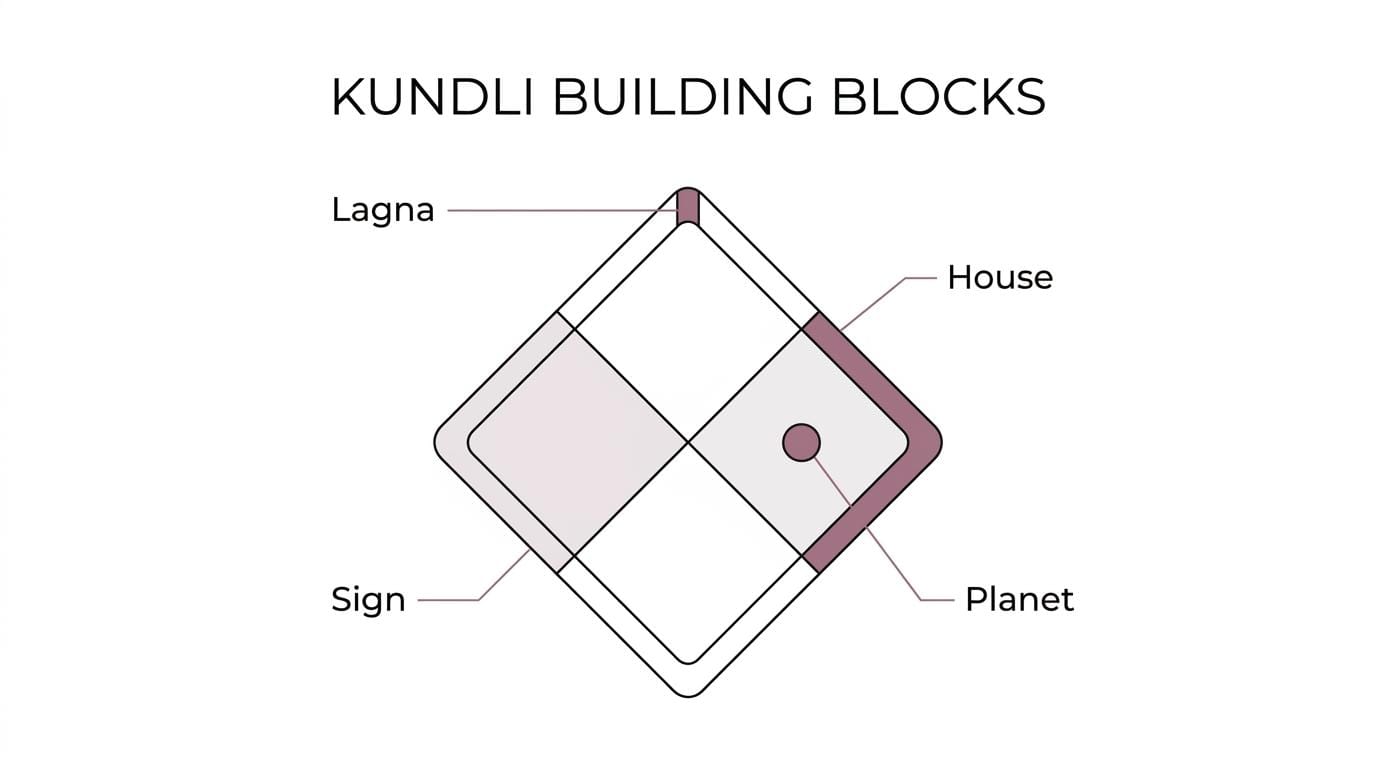
Before you read any single placement, get comfortable with the basic pieces of the chart. If these four make sense, the rest becomes much easier.
- houses
- signs
- planets
- Lagna
Here is the simplest formula many beginners find helpful:
- Planet: what kind of energy is active
- House: which area of life is affected
- Sign: how that energy behaves
- Lagna: the starting point of the whole chart
If you remember only one thing at first, remember this: planet = what, house = where, sign = how.
Why the Lagna is the first thing to read in a Kundli
The Lagna, or Ascendant, is the sign rising on the eastern horizon at your birth time. It sets the first house and determines the order of the houses in your chart. That is why it is usually the best place to begin.
A small birth time change can shift the Lagna, which is also why accurate birth details matter.
The Lagna tells you about your basic orientation toward life, your temperament, and the lens through which the rest of the chart is read. After that, look at the Lagna lord, meaning the planet that rules the sign rising in the first house. That planet becomes a major clue in chart reading.
A beginner table for the 12 houses in a Kundli
The 12 houses are life areas. When a planet sits in a house, it tends to activate that part of life more strongly.
House | Main themes | Easy beginner cue |
|---|---|---|
1st | self, body, identity | how you meet life |
2nd | speech, family, savings | what you store and value |
3rd | effort, courage, siblings, communication | how you act and express |
4th | home, emotions, mother, property | your inner base |
5th | creativity, learning, children | what comes from your mind and heart |
6th | work, service, health issues, debts | what requires discipline |
7th | marriage, partnerships, public dealings | how you relate one-to-one |
8th | change, secrets, vulnerability, longevity | what transforms you |
9th | dharma, teachers, luck, higher learning | what guides your beliefs |
10th | career, reputation, action | what the world sees you doing |
11th | gains, friends, networks, goals | what grows through connection |
12th | loss, rest, foreign lands, release | what asks for surrender |
You do not need to memorize every keyword right away. Start with one short phrase for each house and build from there.
How to read planets in a Kundli
Planets are the active forces in the chart. Each one has a basic nature, and that nature colors the house it occupies.
The Sun points to identity, purpose, visibility, and authority. The Moon relates to mind, emotions, habits, and comfort. Mars shows drive, action, courage, and sometimes conflict. Mercury is linked with speech, logic, trade, and learning. Jupiter speaks to wisdom, faith, teaching, and growth. Venus relates to love, beauty, comfort, and pleasure. Saturn shows duty, effort, time, maturity, and endurance. Rahu and Ketu bring intensity, karmic themes, hunger, release, and unusual focus.
A beginner mistake is to treat every planet as either “good” or “bad.” A better approach is to ask what the planet is trying to do in that part of life, and whether it seems supported, strained, or mixed.
Planet + house + sign: the basic reading formula
Take a simple example. Suppose Mercury is in the 2nd house in Virgo.
You might read that as: Mercury brings speech, analysis, and intelligence; the 2nd house points to family, stored wealth, and voice; Virgo adds detail, precision, and practical thinking. So the person may be thoughtful with words, sharp in analysis, and careful around money or communication.
Now take Venus in the 7th house in Libra. Venus already connects with relationships and harmony. The 7th house rules partnership. Libra also values balance and connection. That gives a strong relationship theme, though the full reading still depends on aspects, house lordship, and planetary strength.
This is why single-line interpretations are useful only as a starting point.
How signs change the tone of a placement
Signs are style. Two people may both have Jupiter in the 10th house, yet the result may feel very different if one has it in Capricorn and the other in Sagittarius.
Signs tell you whether a planet acts in a direct, cautious, emotional, expressive, disciplined, or imaginative way. They do not replace the house meaning. They shape it.
When you read a placement, try saying it in one sentence:
“Planet X is expressing itself in House Y with the style of Sign Z.”
That one sentence can train your eye very quickly.
How to read your Kundli step by step
If you open your chart and feel unsure where to begin, use a repeatable sequence. A fixed method helps you stay calm and keeps you from jumping to dramatic conclusions.
- Find the Lagna: Note the rising sign and the planet that rules it.
- Read the 1st house and Lagna lord: This gives the core tone of the chart.
- Check the Moon sign and Moon house: This adds emotional pattern, habits, and mental focus.
- Look for house concentration: See whether many planets gather in a few houses.
- Read the 10th, 7th, 4th, and 2nd houses: These often give quick insight into career, relationships, home life, and finances.
- Judge each placement with the basic formula: planet, house, sign.
After that, look at house lords. If the ruler of the 10th house sits in the 2nd, career and income may connect strongly. If the ruler of the 7th sits in the 11th, relationships may be linked with networks, social circles, or shared goals.
This is where chart reading starts to feel alive.
Why house lords matter in Kundli reading
House lords show how one part of life connects with another. They add movement to the chart.
Say your Lagna is Aries. That makes Mars the Lagna lord. If Mars sits in the 10th house, your sense of self may be closely tied to achievement, action, and public work. If the 4th lord goes to the 9th, home and belief systems may influence each other strongly.
You do not need advanced techniques to start using house lords. Just ask, “Where did the ruler of this house go?” That one question can sharpen your reading right away.
Common beginner mistakes in Kundli reading
Most beginners do not struggle because the chart is too hard. They struggle because they try to read too much too soon.
A steady pace helps more than memorizing dozens of rules.
- One placement obsession: no single planet tells the whole story
- Mixing up signs and houses: Aries is not always the 1st house in every chart
- Ignoring the Lagna: the house structure depends on it
- Reading fear into Saturn, Rahu, or Ketu: these placements also carry growth, skill, and depth
- Jumping into timing too early: dashas and transits make more sense after the birth chart basics are clear
The kindest way to read a chart is also the clearest way: look for patterns, not panic.
How to practice Kundli reading without getting overwhelmed
Practice works best when it is specific. Open your own chart. Pick one house a day. Then pick one planet a day. Write down what you see in plain English.
A good note does not need to sound technical. “My Moon is in the 4th house, so emotional security and home matter a lot to me” is a useful beginner note. It is simple, readable, and easy to build on later.
You can also compare three charts and ask one question only, like: “How is the 10th house different in each chart?” That keeps your practice focused.
Using StarYaar to learn how to read a Kundli
Learning is easier when the chart is accurate and the explanations are clear. That is where a modern tool can save time and reduce confusion.
StarYaar is built to make Vedic astrology more approachable for beginners. You can generate a free Kundli, review chart details on any device, and get AI-based interpretations in straightforward language. The platform uses Swiss Ephemeris accuracy and supports tools that help you move from raw chart data to practical reading.
A beginner may find these features especially helpful:
- Free Kundli generation: create your birth chart without signup
- AI readings: get plain-language interpretations for key placements
- Dasha timeline: see when major planetary periods become active
- Daily horoscope and transits: connect your birth chart with current movement
- Divisional charts: study deeper layers when you are ready
- Privacy-first access: check your chart without handing over more data than needed
The useful part is not just getting a report. It is being able to compare the report with your own reading and ask, “Do I see how this was interpreted?” That is how confidence grows.
If you are just starting out, a simple practice routine can help:
- generate your chart
- identify your Lagna, Moon sign, and 10th house
- read one AI explanation
- rewrite it in your own words
- repeat with one new placement the next day
That kind of repetition builds real skill.
Build confidence by reading the chart as a whole
A Kundli is not a test you pass in one sitting. It is a language you get used to over time.
Start with the Lagna. Learn the houses. Read planets as active forces. Let signs tell you the tone. Add house lords when you feel ready. Then, little by little, the chart stops looking like a puzzle and starts feeling like a clear, meaningful pattern you can actually read.