What Is a Natal Chart in Vedic Astrology?


Learn what a natal chart means in Vedic astrology, how it’s calculated, and how signs, houses, dashas, and nakshatras shape life.
Your natal chart is a sky map for the exact moment and place you were born. In Vedic astrology, that map is called a Kundli or Janma Kundli.
It shows where the grahas, the Ascendant, and the Moon’s nakshatra were placed in the sidereal zodiac at birth. From that one chart, astrologers read temperament, life themes, timing, relationships, career patterns, and spiritual leanings. The chart itself is a calculation. The meaning assigned to it is interpretation.
Vedic natal chart definition
A Vedic natal chart is a birth chart calculated from your date, exact time, and place of birth using the sidereal zodiac used in Jyotish. In simple terms, it is the foundational chart for reading a person’s life pattern in Vedic astrology.
This chart is usually drawn as a North Indian, South Indian, or East Indian style diagram, but the layout style does not change the underlying data. The key factors are the Lagna or Ascendant, the 12 houses, the 12 rashis or signs, the 9 grahas used in Jyotish, and the Moon’s nakshatra. Classical texts like Brihat Parashara Hora Shastra, Phaladeepika, and Jataka Parijata form much of the interpretive backbone used by astrologers today.
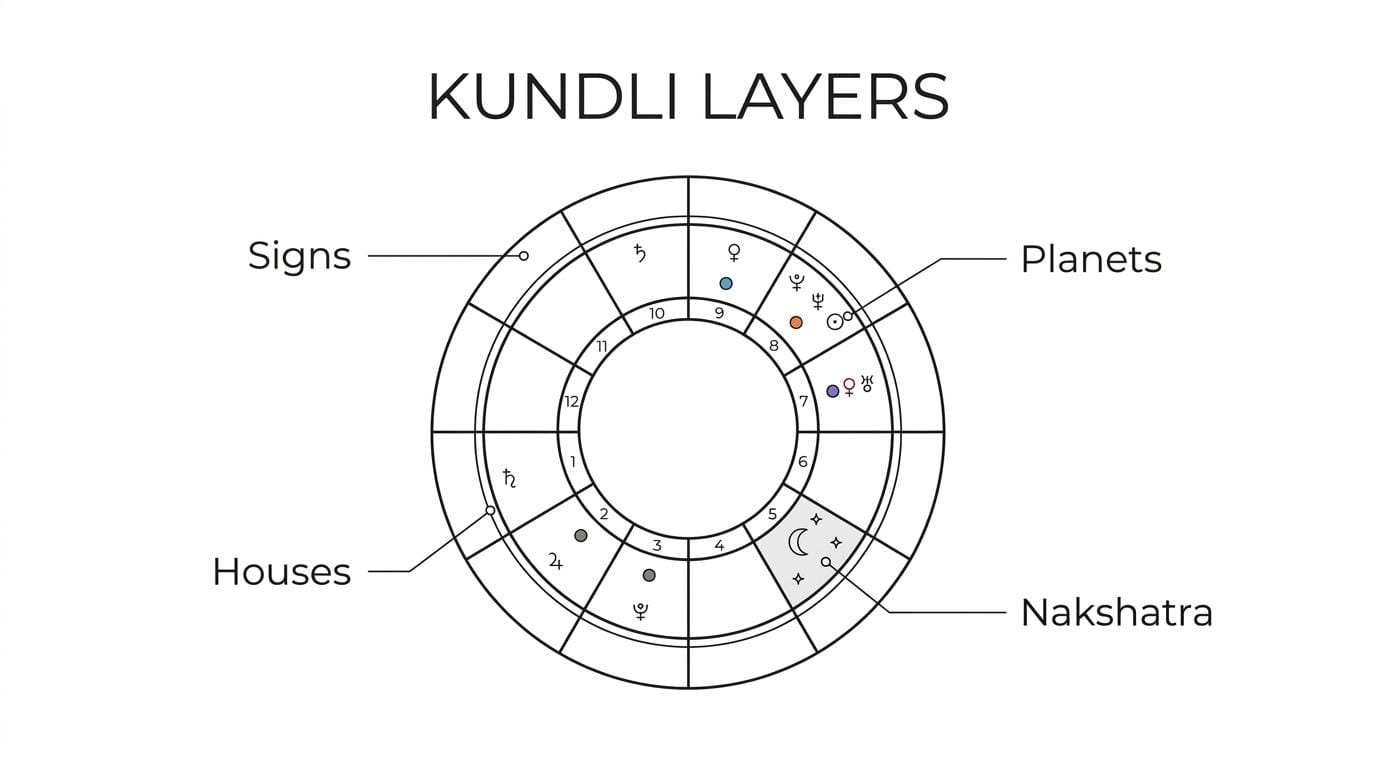
Labeled Vedic natal chart diagram showing Ascendant, houses, signs, grahas, and Moon nakshatra as linked layers.
A natal chart is not just a personality profile. In Vedic astrology, it is also the starting point for timing systems like Vimshottari Dasha, for checking yogas, and for studying divisional charts like Navamsha (D9) and Dashamsha (D10).
After the core chart is calculated, astrologers usually read layers like these:
- Ascendant and house structure
- Planetary sign placements
- Nakshatra positions
- House lordships
- Yogas and doshas
- Dasha timeline
- Current transits
- Divisional charts
Natal chart calculation in Vedic astrology
Natal chart calculation is the process of converting birth data into exact sidereal planetary longitudes and house positions. The required inputs are simple, but the accuracy standard needs to be high.
The three required inputs are birth date, time, and location. From there, an astrology engine calculates the positions of the Sun, Moon, Mars, Mercury, Jupiter, Venus, Saturn, Rahu, and Ketu. It also computes the Ascendant, which can change quickly, especially near sign boundaries. This is why a difference of even a few minutes can sometimes shift the Lagna and house cusps.
Vedic astrology uses the sidereal zodiac, while most Western natal astrology uses the tropical zodiac. Because of the precession of the equinoxes, the two zodiacs drift apart over time by about 1 degree every 71.6 to 72 years. To convert tropical positions into sidereal ones, astrologers apply an offset called ayanamsha. A widely used standard in India is the Lahiri ayanamsha, which is also tied to recognized Indian calendric practice.
Why birth time matters for a natal chart
Birth time matters because the Ascendant and house structure can shift fast, and that changes the whole chart framework.
A practical calculation flow looks like this:
Calculation layer | What it means | Why it matters |
|---|---|---|
Birth date | Calendar day of birth | Sets the baseline astronomical positions |
Birth time | Exact local time | Determines Ascendant, houses, and fast-moving Moon details |
Birth place | Latitude and longitude | Adjusts local sky orientation |
Ephemeris | Planetary position database | Produces precise graha longitudes |
Ayanamsha | Sidereal correction value | Converts chart into the Vedic zodiac framework |
House system and chart style | Organizes planets into houses | Shapes interpretation through house meanings |
Nakshatra mapping | Moon and planets into lunar mansions | Powers dasha logic and finer interpretation |
Many modern platforms use Swiss Ephemeris for astronomical precision. When paired with Lahiri ayanamsha, it gives a calculation framework that is familiar to many Vedic astrologers and users across India and the diaspora.
Natal chart parts: planets, houses, signs, and nakshatras
A natal chart is made of interlinked components, not isolated labels. The meaning comes from how planets, houses, signs, nakshatras, aspects, and lordships work together.
The 12 houses show areas of life. The 12 signs show style and expression. The planets show the forces acting in the chart. Nakshatras add a finer lunar layer that often gives sharper psychological and timing detail than sign placement alone.
A quick way to read the chart structure is to know what each layer does:
- Planets: The active forces, including Sun, Moon, Mars, Mercury, Jupiter, Venus, Saturn, Rahu, and Ketu
- Houses: The life areas, from self and body in the 1st house to loss and liberation in the 12th
- Signs: The temperament and mode through which a planet acts
- Nakshatras: The subtle lunar sectors that shape behavior, instincts, and dasha timing
- House lords: The rulers that link one life area to another
- Aspects: Planetary influence across houses and signs
- Yogas: Meaningful combinations that can support wealth, status, learning, creativity, or inner strain
Take one simple example. If Jupiter is in the 9th house, that may point toward teachers, ethics, higher learning, or guidance. But the final reading changes if Jupiter is exalted, debilitated, retrograde, afflicted by Saturn, placed in a difficult nakshatra, or running its Mahadasha. The single placement is only the first layer.
Natal chart interpretation: dashas, yogas, and divisional charts
Natal chart interpretation is the process of reading the birth chart as a connected system. In Vedic astrology, this means reading placement, strength, timing, and context together.
A chart is rarely judged from one factor alone. Astrologers check the Lagna, Moon, house lordships, dignity, conjunctions, aspects, shadbala or other strength measures, yogas, and divisional charts. Then they compare those findings with the running Mahadasha and Antardasha, since the dasha period shows which planetary themes are active in time.
This is one of the most useful relationship maps in Jyotish: the natal chart shows potential, the dasha shows timing, and transits show triggers. A strong career yoga may stay quiet for years, then become visible when the yoga-forming planet runs its Mahadasha and receives supportive transit contact from Jupiter or Saturn. In the same way, a difficult natal placement may feel manageable until a matching dasha and transit combination activates it.
Highlighted quote about natal chart potential, dasha timing, and transit triggers.
Divisional charts refine the picture. The D9 Navamsha is widely used for marriage, dharma, maturity, and planetary strength. The D10 Dashamsha is often checked for career and public role. A birth chart may show promise, but the divisional chart tells you where that promise holds firm and where it needs effort.
Example of natal chart interpretation in Vedic astrology
A Taurus Ascendant chart with Moon in Rohini, Saturn in the 10th, and Venus strong could suggest steadiness, aesthetic sense, patience, and career growth through consistent work rather than sudden jumps.
If that same person enters a Saturn Mahadasha while Saturn is well placed in the natal chart, the period may bring responsibility, structure, promotions, or a serious career turn. If transiting Jupiter supports the 10th house or Saturn, those themes may become more visible. If the D10 is weak, the same period may still bring work pressure before outward reward. The chart gives a range. Timing tells you when that range becomes active.
Vedic natal chart vs Western natal chart
A Vedic natal chart and a Western natal chart are both birth charts, but they are built on different zodiac frameworks and often read with different timing tools.
The biggest difference is the zodiac basis. Vedic astrology usually uses the sidereal zodiac. Western astrology usually uses the tropical zodiac. That means the sign positions for the same birth can differ, even though the birth data is identical.
Feature | Vedic natal chart | Western natal chart |
|---|---|---|
Zodiac basis | Sidereal | Tropical |
Correction factor | Ayanamsha used | No sidereal ayanamsha in standard tropical practice |
Lunar detail | Strong focus on nakshatras | Usually less central |
Timing methods | Vimshottari Dasha and other dashas | Transits, progressions, solar returns |
House emphasis | Strong house lordship logic | Strong house and aspect logic, with school-by-school variation |
Divisional charts | Core interpretive tool | Usually not used in the same way |
This does not mean one is “right” and the other is “wrong.” It means they use different astronomical reference frameworks and different interpretive traditions.
Natal chart misconceptions in Jyotish
A natal chart is often misunderstood as a fixed sentence about fate. That is not how many serious astrologers read it.
The chart shows tendencies, strengths, friction points, timing windows, and areas that respond well to effort. It does not remove free will, character, learning, or practical action. A difficult Saturn can still build mastery. A strong Jupiter still needs wise choices.
A few common misconceptions are worth clearing up:
- My chart is bad: Most charts show both supportive and difficult factors
- One dosha decides everything: No single label should override the full chart
- My Sun sign is my whole identity: Vedic chart reading depends heavily on Lagna, Moon, house lords, and dashas
- Birth time can be approximate: Even small time shifts can change the Ascendant and divisional charts
- A yoga guarantees results: Yogas need strength, activation, and timing to produce visible outcomes
Fear-based chart reading usually comes from over-isolating one placement. Good Jyotish reading puts every factor back into context.
Natal chart source transparency: ayanamsha, ephemeris, and texts
Natal chart source transparency means being clear about what is calculated, what is interpreted, and which reference system is used. This makes astrology easier to trust and easier to compare across platforms.
Here is the cleanest way to separate the layers. Fact: the chart calculation uses birth coordinates, astronomical planetary positions, and a chosen ayanamsha. Interpretation: the meaning of those placements comes from Jyotish rules, textual traditions, and reading logic. When an astrology platform states that it uses Swiss Ephemeris and Lahiri ayanamsha, that is a methodological claim about calculation, not a promise about life outcomes.
Many users also want to know what a modern chart output includes. A platform like StarYaar describes its Kundli output as combining the birth chart with Vimshottari Dasha, yogas, real-time transits, and divisional charts from D1 to D60. That kind of layered output matches how many astrologers actually read charts: not as one static image, but as a system of linked datasets.
For people comparing tools, these are the questions that matter most:
- Ayanamsha used: Lahiri, Raman, Krishnamurti, or another standard
- Ephemeris source: Swiss Ephemeris or another astronomical engine
- Chart layers included: Dasha, yogas, divisional charts, transit overlay
- Interpretation logic: Text-based rules, AI summaries, or human-written notes
Natal chart FAQs
A natal chart FAQ is useful because most beginners ask the same few questions before they can read their chart with confidence.
Is a natal chart the same as a Kundli?
Yes. In Vedic astrology, a natal chart is commonly called a Kundli, Janma Kundli, or birth chart. The terms are often used interchangeably.
Which is more important in Vedic astrology: Sun sign, Moon sign, or Ascendant?
All three matter, but they do different jobs. The Ascendant shapes the house structure and physical-life orientation. The Moon sign is central for mind, emotion, and dasha starting logic. The Sun shows vitality, authority, and soul-centered purpose. In many Vedic readings, Lagna and Moon carry more practical weight than a simple Sun-sign reading.
Can I read my natal chart without divisional charts?
Yes, you can begin with the main D1 Rashi chart. Still, many finer judgments need divisional charts. Marriage readings often check D9. Career readings often check D10. Without them, the reading may stay broad.
What if I do not know my exact birth time?
You can still generate a partial chart using date and place, but the Ascendant, houses, and divisional charts may be unreliable. Moon sign and some planetary placements may remain useful. If time is uncertain, birth time rectification may help.
Why do two astrology sites give different chart results?
The usual reasons are different ayanamsha choices, time zone handling, daylight saving adjustments, house calculation settings, or data entry differences. Even a small birth-time mismatch can create visibly different outputs.
If you have your birth date, time, and place, your natal chart can give you much more than a sign label. It can show how planets, houses, nakshatras, yogas, dashas, and transits work together, which is where Vedic astrology becomes far more specific and far more useful.
A natal chart FAQ is a good place to start.