What Is Raj Yoga in a Birth Chart?


Learn what raj yoga means in a birth chart, how it forms through Kendra and Trikona lords, and what affects its strength and timing.
Raj Yoga is one of the most talked-about combinations in Vedic astrology, yet it is also one of the most misunderstood. Many people hear that it means power, success, or status and assume it is a blanket label for a “great chart.” Classical Jyotish is more specific than that.
In most standard Vedic interpretations, Raj Yoga forms when the lords of angular houses, called Kendras, connect with the lords of trinal houses, called Trikonas. The key idea is simple: when action and structure meet merit and luck, the chart can show capacity for leadership, recognition, support from institutions, or a rise in life.
That does not mean every Raj Yoga gives dramatic fame. Results depend on planetary strength, house placement, divisional confirmation, and timing through dasha and bhukti.
Raj Yoga definition in Vedic astrology
Raj Yoga is a planetary combination created by a relationship between Kendra lords and Trikona lords in a birth chart. In Jyotish, the Kendra houses are the 1st, 4th, 7th, and 10th. The Trikona houses are the 1st, 5th, and 9th. Since the 1st house belongs to both groups, the Lagna lord becomes especially important.
Classical texts and later tradition treat these houses as powerful because they combine life direction with purpose and grace. Kendras are structural pillars of the chart. Trikonas are linked with dharma, past merit, talent, intelligence, and blessings. When their lords join or strongly influence one another, the result is said to support authority, achievement, or favorable circumstances.
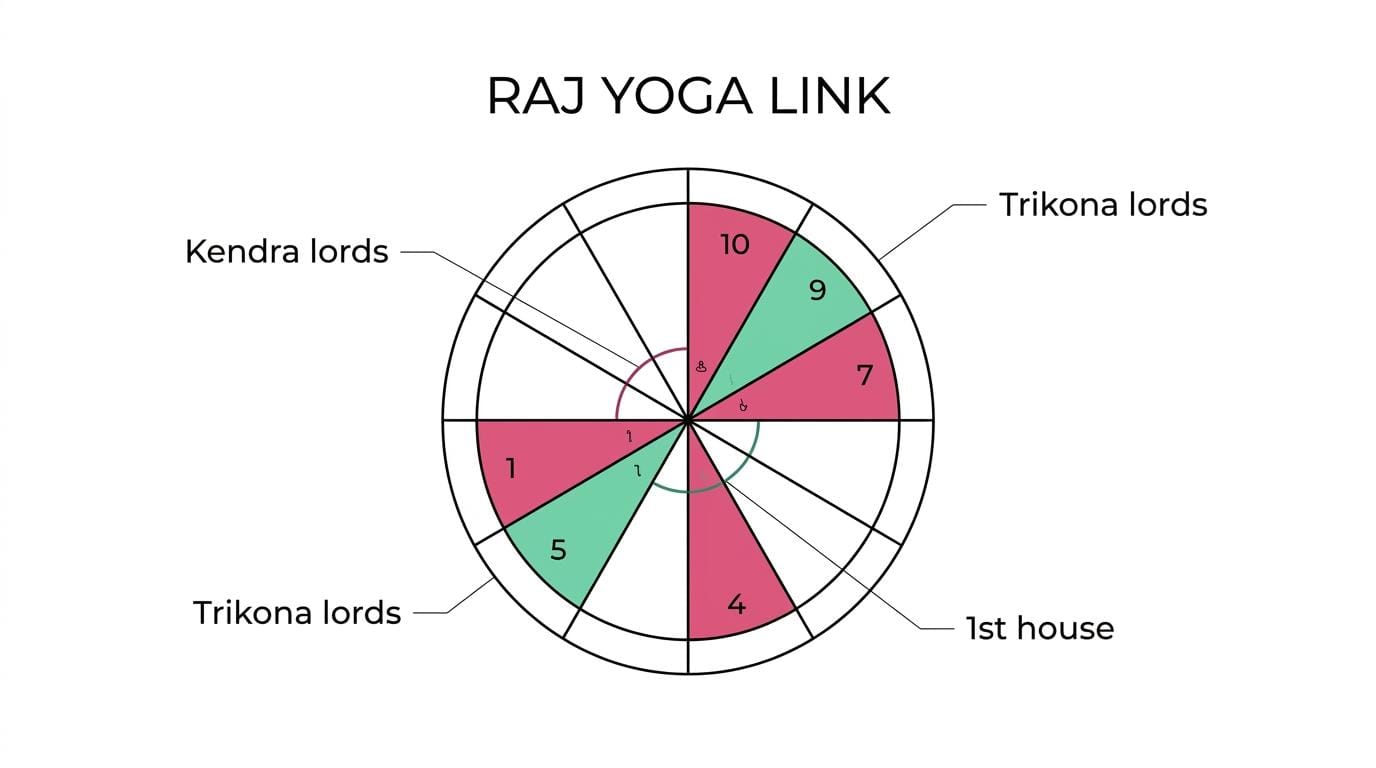
Labeled astrology house diagram highlighting the Kendra houses, Trikona houses, and the shared 1st house.
The phrase “results worthy of a king” should be read in a modern way. In current life, Raj Yoga often points to influence, leadership, institutional backing, social respect, professional rise, and the ability to make things happen.
Raj Yoga calculation using Kendra and Trikona lords
Raj Yoga calculation is the process of checking whether Kendra and Trikona lords form a meaningful connection in the birth chart. The core chart used first is the D1, or Rashi chart. The method is rule-based, not vague.
Start by identifying the ascendant sign, then assign house lordship from that Lagna. After that, check whether the lords of the 1st, 4th, 7th, and 10th connect with the lords of the 1st, 5th, and 9th. A connection can be strong even if the planets are not in the same house.
The most common links checked are:
- Conjunction
- Mutual aspect
- Parivartana, or exchange of signs
- Placement in Kendra or Trikona houses with close interaction
- Shared dispositor or repeated linkage across D1 and D9
A clean example is a 9th lord joining the 10th lord. This is often called a Dharma-Karma connection and is widely treated as one of the strongest Raj Yoga patterns. Another important case is when one planet owns both a Kendra and a Trikona. That planet is called a Yogakaraka.
A practical note matters here. Accurate calculation depends on correct birth time, sidereal zodiac settings, house lordship, and the ayanamsha chosen. Many Jyotish tools use Lahiri ayanamsha, and platforms may use Swiss Ephemeris for precise planetary positions. The yoga rule itself is classical, but the chart math still needs to be right.
Strong Raj Yoga combinations, Yogakaraka planets, and house links
Strong Raj Yoga combinations are the specific lordship patterns that tend to give clearer results. The most praised among them is the 9th lord linked with the 10th lord because it joins dharma, fortune, and career karma. In many readings, this combination is stronger than a generic “good placement” because it has a defined structural basis.
The 1st lord also deserves special attention. Since the Lagna is both Kendra and Trikona, a strong ascendant lord can support Raj Yoga potential across the whole chart. If the Lagna lord is weak, afflicted, or trapped in a difficult house, even a textbook Raj Yoga may produce smaller outcomes.
Some ascendants produce a Yogakaraka planet, which means one planet rules both a Kendra and a Trikona. These planets often become key carriers of success, especially in their mahadasha or antardasha.
Ascendant | Yogakaraka or notable Raj Yoga link | Why it matters |
|---|---|---|
Taurus | Saturn as 9th and 10th lord | Classic Dharma-Karma power |
Cancer | Mars as 5th and 10th lord | Talent linked to career action |
Leo | Mars as 4th and 9th lord | Fortune supports stability and authority |
Libra | Saturn as 4th and 5th lord | Strong support for status and intelligence |
Capricorn | Venus as 5th and 10th lord | Creativity and merit aid career |
Aquarius | Venus as 4th and 9th lord | Fortune, comfort, and support combine |
This table is a shortcut, not a verdict. A Yogakaraka planet still needs strength, dignity, and decent placement to deliver fully.
Raj Yoga strength factors: dignity, dusthana influence, and navamsa
Raj Yoga strength is the difference between a chart promise and a lived result. Two people can have the same basic yoga on paper, yet only one may feel its effect strongly.
The first test is planetary condition. A yoga-forming planet in its own sign, exaltation sign, or a supportive house is usually more capable of giving results. Severe debilitation, harsh affliction, or damage to the Lagna can reduce expression. Dusthana involvement also matters, especially the 6th, 8th, and 12th houses. These houses do not cancel Raj Yoga automatically, but they can redirect the results into struggle, delay, service, research, foreign settings, or transformation before success.
When checking strength, astrologers commonly review:
- Dignity: own sign, exalted, debilitated, enemy sign
- Affliction: combustion, malefic aspects, papakartari, nodes
- House placement: Kendra, Trikona, Dusthana, upachaya
- Support: benefic aspects from Jupiter, Venus, or a waxing Moon
- Divisional confirmation: Navamsa (D9), Dashamsha (D10), other vargas
- Dispositor chain: whether the sign lord of the yoga planet is strong
[Jakshatra-level analysis can refine the story further, since the nakshatra lord and sub-lord context may support or complicate the yoga.]
Navamsa can change the reading a lot. A planet that looks decent in D1 but falls into weakness in D9 may not sustain results. The opposite can also happen. Nakshatra-level analysis can refine the story further, since the nakshatra lord and sub-lord context may support or complicate the yoga.
Raj Yoga timing through dasha, bhukti, and transits
Raj Yoga timing is the process of seeing when the promised results are likely to show up. A yoga in the chart is potential. Activation usually comes through planetary periods.
Highlighted quote stating that Raj Yoga is potential until planetary periods activate it.
In classical-style practice, the mahadasha and antardasha of the yoga-forming planets are the first windows to watch. If the 9th lord and 10th lord form Raj Yoga, their dasha periods often bring career movement, recognition, promotion, or support from mentors and institutions. If the Lagna lord joins the pattern, personal confidence and decision-making may also rise at the same time.
Transits modify the timing. Jupiter transiting over the yoga houses, aspecting the Lagna, or activating the 10th can open doors. Saturn can bring responsibility, rank, or stable gains, though often after effort. The interaction matters: mahadasha sets the main theme, bhukti narrows it, and transits trigger events.
A simple rule helps. If a Raj Yoga exists but the relevant dasha never comes during active life years, the yoga may stay modest. If the dasha comes but the planets are weak, results may appear in partial form.
Raj Yoga examples by ascendant and house lordship
Raj Yoga examples make the rule easier to grasp. The pattern is always house-based first, not slogan-based.
Take Aries ascendant. The 9th lord is Jupiter and the 10th lord is Saturn. If Jupiter and Saturn join in a strong house, or aspect each other with dignity, a Raj Yoga theme may form. Whether it feels favorable depends on dignity, affliction, and timing.
Take Cancer ascendant. Mars rules the 5th and 10th houses, making it a Yogakaraka. If Mars is strong, placed in a Kendra or Trikona, and supported by benefics, the chart can show leadership and career drive. If the same Mars is debilitated, heavily afflicted, or tied to difficult houses without support, the yoga may still exist but work through pressure and long effort.
One more example helps clarify the 1st lord issue. For Libra ascendant, Venus is the Lagna lord, and Saturn rules the 4th and 5th, making Saturn a Yogakaraka. If Venus and Saturn connect strongly, the chart may show refined authority, stable growth, public respect, or a role where judgment matters.
Raj Yoga misconceptions and related yogas
Raj Yoga misconceptions usually come from treating the term as a blanket promise of wealth, fame, or easy life. That is not how Jyotish works.
A few corrections are useful:
- Not every strong chart is Raj Yoga: a chart may be powerful because of Dhana Yoga, Neecha Bhanga, strong Lagna, or excellent dashas without a textbook Raj Yoga.
- Raj Yoga is not always fame: it can show rank, influence, support, competence, or local authority rather than celebrity.
- One yoga never overrides the whole chart: Arishta factors, weak Moon, harsh dasha periods, or poor D10 support can change the lived result.
- “Raj” in the name does not mean the same yoga: Raj Yoga, Rajalakshana Yoga, and other named yogas follow different formation rules.
That last point is worth pausing on. Rajalakshana Yoga is a separate classical combination and should not be confused with the standard Kendra-Trikona Raj Yoga rule. Many astrology pages mix named yogas together, but serious interpretation keeps the definitions separate.
Related concepts help complete the picture. Dhana Yoga focuses on wealth combinations. Vipareeta Raja Yoga works through lords of difficult houses and can produce gains after adversity. Yogakaraka refers to a planet that rules both a Kendra and a Trikona. These are related but not identical ideas.
Raj Yoga summary and quick reference
Raj Yoga summary is simple: it is a defined connection between Kendra lords and Trikona lords, not just a compliment for a “good horoscope.” The most valued versions often involve the 9th and 10th lords, the Lagna lord, or a Yogakaraka planet.
When checking a chart, keep this quick filter in mind:
- Find the ascendant and house lords
- Check Kendra and Trikona lord connections
- Judge dignity and affliction
- Confirm in D9 and, for career, D10
- Time it through mahadasha, antardasha, and transits
Interpretation should stay realistic. A strong Raj Yoga can point to rise, but it does not erase effort, timing, family conditions, education, or free will. In modern readings, the best use of this yoga is not fear or hype. It is clarity about where support, opportunity, and leadership potential may already exist.
Raj Yoga FAQ for common chart questions
Can Raj Yoga exist if the planets are not conjunct?
Yes. Mutual aspect, sign exchange, and other strong links can form the yoga. Conjunction is common, but it is not the only valid pattern.
Is the 9th lord and 10th lord combination always the best?
It is often treated as one of the strongest classical forms because it links dharma and karma directly. Still, “best” depends on strength. A damaged 9th and 10th lord pair can underperform, while a very strong Yogakaraka may produce clearer results.
Does Raj Yoga guarantee wealth?
No. Wealth is seen more directly through Dhana Yogas, the 2nd and 11th houses, Jupiter, Venus, and supporting dashas. Raj Yoga is more about authority, status, rise, support, and influence. Wealth may follow, but it is not automatic.
Can Raj Yoga give results late in life?
Yes. Timing depends on dasha and transits. Some people have the promise early but feel it only when the relevant mahadasha or bhukti begins. Saturn-linked Raj Yogas often mature with age and responsibility.
What if Raj Yoga is in a Dusthana house?
The yoga may still operate, but the path can involve strain, service, crisis management, research, foreign residence, or delayed recognition. This is a good example of why chart context matters more than labels.
Should Raj Yoga be checked only in the birth chart?
No. D1 is the base chart, but D9 helps assess strength and durability. D10 is especially useful when the yoga is expected to show through career, visibility, management, or public role.