How Mahadasha and Antardasha Work

Learn how mahadasha and antardasha shape Vedic astrology timing, revealing life themes, subperiods, and key transition phases.
If you have ever looked at a Vedic birth chart and wondered, “This says what may happen, but when does it happen?” you are asking the exact question that dasha systems are meant to answer.
Mahadasha and Antardasha are two of the most helpful timing tools in Jyotish. They turn a birth chart from a static map into a living timeline. Instead of reading every promise in the chart all at once, they show which themes are active now, which ones are waiting, and which ones may become stronger in the next few months or years.
That makes them useful not because they remove free will, but because they give context. A period can be great for study, relationship growth, rebuilding finances, deep inner work, or taking on responsibility. The key is knowing what kind of season you are in.
Mahadasha and Antardasha meanings in Vedic astrology
In simple terms, a Mahadasha is a major planetary period, and an Antardasha is a smaller period inside it.
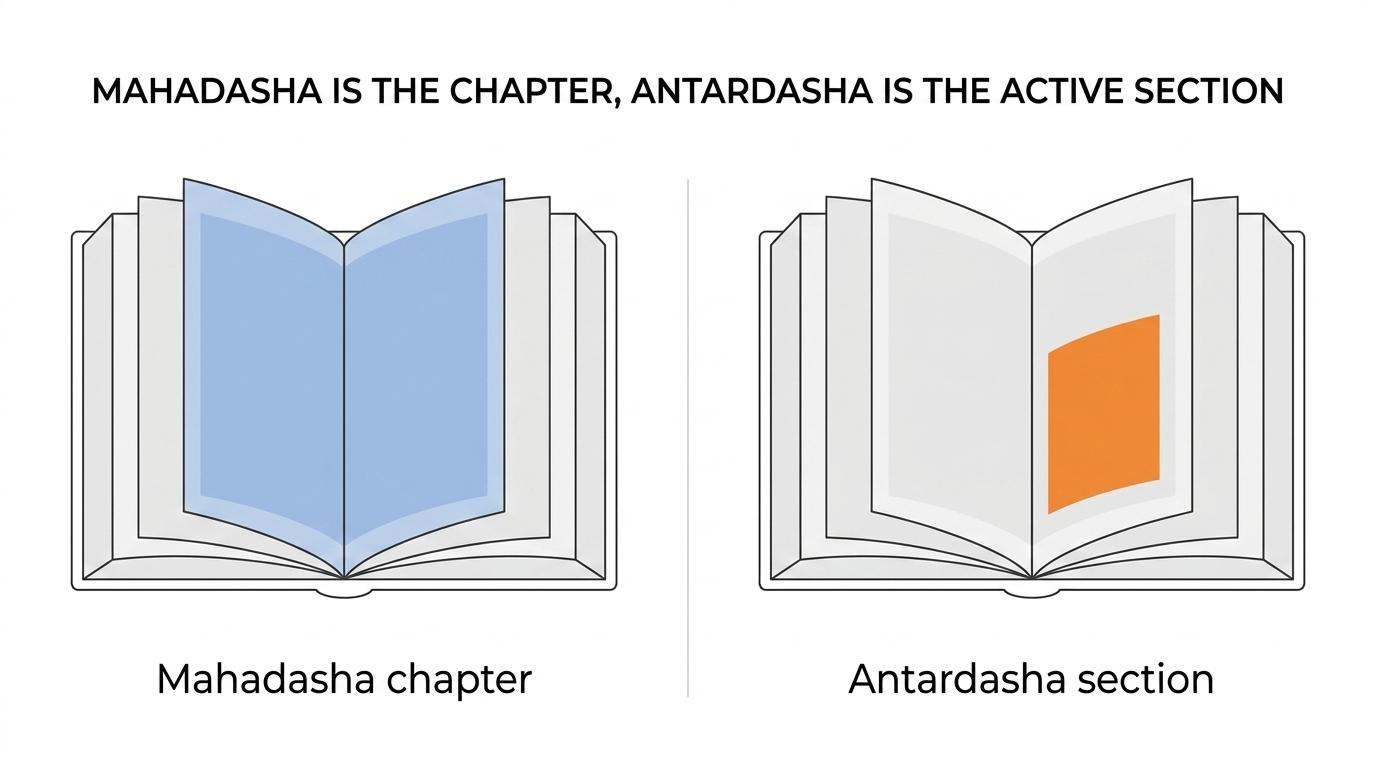
A helpful way to picture this is to think of your life as a book. The Mahadasha is the chapter. The Antardasha is the section inside that chapter. If you are in Jupiter Mahadasha, Jupiter sets the broad tone for a long stretch of life. If you are then in Jupiter-Moon Antardasha, the Moon adds a more specific flavor during that part of the chapter.
This is why two people in the same Mahadasha can still have very different experiences. The Mahadasha gives the background. The Antardasha shows what is being activated inside that background.
In many readings, Antardasha is also called bhukti.
Vimshottari Dasha cycle and planetary periods
The most widely used dasha system in Vedic astrology is Vimshottari Dasha. It divides life into a 120-year planetary cycle. Each planet rules a fixed number of years, and the order repeats in the same pattern.
Here is the standard sequence used in practice:
| Planet | Mahadasha Length |
|---|---|
| Ketu | 7 years |
| Venus | 20 years |
| Sun | 6 years |
| Moon | 10 years |
| Mars | 7 years |
| Rahu | 18 years |
| Jupiter | 16 years |
| Saturn | 19 years |
| Mercury | 17 years |
These periods are not randomly assigned. They come from the classical Vimshottari framework, which is tied to the Moon’s nakshatra at birth. That is why exact birth details matter. Even a small difference in birth time can affect the Moon’s placement, the ascendant, divisional charts, and timing details.
Each planet tends to bring forward its own style of experience. Still, no Mahadasha is automatically “good” or “bad.” Much depends on the birth chart itself.
After looking at the list above, it helps to keep three ideas in mind:
- Planetary symbolism
- House rulership
- Chart strength
- Planetary relationships
- Current transits
A Venus Mahadasha may bring attention to relationships, comfort, art, agreements, or finances. A Saturn Mahadasha may bring discipline, duty, slow-building results, maturity, and pressure to get serious. But these are only starting points. The real reading depends on where those planets sit in the chart, which houses they rule, and how they connect with other planets.
Birth Moon nakshatra and the first Mahadasha
Your first Mahadasha is decided by the nakshatra occupied by the Moon at birth. Every nakshatra has a planetary ruler. That ruler becomes the starting Mahadasha.
There is one important detail: you do not always begin at the full length of that Mahadasha. You begin with the remaining balance of it.
That balance is based on how far the Moon has already moved through its birth nakshatra. If the Moon has just entered the nakshatra, most of that Mahadasha is still left. If the Moon is near the end of the nakshatra, only a small part of that Mahadasha remains.
A simple example makes this easier. Imagine the Moon is in a Mars-ruled nakshatra, and it has completed about 25% of that nakshatra at birth. Mars Mahadasha is 7 years long. If 25% has already passed, then roughly 75% remains. So the person begins life with about 5.25 years of Mars Mahadasha left.
The basic process looks like this:
- Step 1: Find the Moon’s exact sidereal position at birth
- Step 2: Identify the birth nakshatra
- Step 3: Note the nakshatra ruler
- Step 4: Measure how much of that nakshatra remains
- Step 5: Apply that fraction to the Mahadasha length
This is one reason accurate chart calculation matters so much. Dasha timing is mathematical before it becomes interpretive.
Antardasha calculation inside a Mahadasha
Every Mahadasha contains nine Antardashas, one for each planetary ruler in the Vimshottari sequence. The first Antardasha is always ruled by the Mahadasha lord itself.
So if you are in Jupiter Mahadasha, the Antardasha sequence will move through Jupiter, Saturn, Mercury, Ketu, Venus, Sun, Moon, Mars, and Rahu.
That nested structure gives much more precision. A 16-year Jupiter Mahadasha is a long period. Life can change a lot inside it. Jupiter-Jupiter may feel very different from Jupiter-Saturn or Jupiter-Venus, even though all three belong to the same larger chapter.
The standard proportional rule is:
Antardasha length = (Mahadasha years × Antardasha years) / 120
Take Jupiter Mahadasha as an example. Jupiter rules 16 years. Mercury rules 17 years in the Vimshottari cycle. So Jupiter-Mercury Antardasha lasts:
16 × 17 / 120 = 2.27 years approximately
That is why Antardashas can feel very noticeable. They are not random short phases. They are mathematically linked to the bigger Mahadasha and carry both planets at once.
Interpreting Mahadasha and Antardasha together
This is where dasha reading becomes more than memorizing planet meanings.
A planet does not give results only because of its natural symbolism. It also gives results based on house ownership, house placement, dignity, conjunctions, aspects, yogas, and divisional chart support. The relationship between the Mahadasha lord and Antardasha lord matters too.
Think of the Mahadasha lord as the main setting and the Antardasha lord as the active trigger. If the two planets support each other in the chart, the subperiod often feels more coherent and productive. If they clash, the period may bring mixed signals, delays, inner tension, or growth through effort.
Astrologers often check a few things before saying a period is likely to favor career, marriage, study, relocation, or spiritual practice:
- House focus: Which houses do the Mahadasha and Antardasha lords rule or occupy?
- Planet condition: Are those planets strong, weakened, combust, retrograde, exalted, or under pressure?
- Planet connection: Do the two lords aspect each other, join each other, or exchange signs?
- Transit support: Are current transits helping the promise show up in real time?
This is why blanket statements can mislead people. Rahu Mahadasha is not automatically chaotic. Saturn Mahadasha is not automatically heavy. Venus Mahadasha is not automatically easy. A strong, well-placed Saturn can build lasting success. A difficult Venus can bring confusion in relationships or spending. The chart always comes first.
Common Mahadasha and Antardasha themes in real life
A few examples can make the logic more tangible.
In Jupiter-Moon, people often feel pulled toward family matters, education, emotional growth, teaching, healing, or home-centered decisions. If both planets are well placed, this can be a nurturing and fertile period for both inner and outer growth.
In Saturn-Venus, there may be focus on commitment, long-term relationships, practical finances, property, design, or creative work that needs discipline. It can bring solid results, though rarely in a rushed way.
In Mars-Saturn, life may ask for patience under pressure. There can be ambition, hard work, engineering or technical focus, physical effort, and situations where timing must be handled carefully. When used well, this combination can produce stamina and serious achievement.
In Rahu-Jupiter, themes of expansion, foreign links, unconventional learning, public growth, or philosophical questioning can become strong. In some charts, it opens doors quickly. In others, it asks for better judgment and clearer values.
One period does not define your whole future.
That point matters. A difficult Antardasha inside a strong Mahadasha may feel like a demanding season, not a life sentence. A beautiful Antardasha inside a more serious Mahadasha may bring relief, connection, or a needed opening.
Mahadasha transitions and real-life timing
People often notice major shifts when a Mahadasha changes, especially if the new lord is very different from the old one.
A move from Venus Mahadasha to Sun Mahadasha can bring a shift from comfort, bonding, and pleasure toward visibility, authority, health, responsibility, or identity. A move from Moon Mahadasha to Mars Mahadasha can feel like going from reflection and emotional processing to action and urgency.
The end of one Antardasha and the start of another can also be felt clearly. Sometimes the change is external, like a new job, relationship, move, or study path. Sometimes it is internal first. Priorities change. Confidence changes. What feels worth pursuing changes.
This is one reason astrologers watch transitions closely instead of only looking at the middle of a period.
Using dasha periods for practical choices
Dasha timing can be very grounding when used well. It does not need to make life feel fixed or frightening. It can help you work with the season you are in.
If your chart shows a study-focused or skill-building period, that is encouraging. If it shows a slower, more demanding period, that can still be useful. Some phases are better for planting than harvesting. Some are better for repair, discipline, and quiet preparation.
A practical way to use Mahadasha and Antardasha is to ask better questions:
- What part of life is asking for attention now?
- What comes more naturally in this period?
- What needs patience?
- Where can steady effort pay off?
- What support would help me use this phase well?
That approach keeps astrology constructive.
You can also use dasha timing alongside other chart tools:
- Daily use: track mood, focus, and timing patterns
- Planning use: choose better windows for applications, launches, or relationship talks
- Reflection use: make sense of why a certain life topic keeps returning
- Growth use: work with the strengths of the current period instead of resisting every part of it
When Mahadasha and Antardasha are read with care, they do something very helpful. They take the chart out of abstraction and place it on a timeline you can actually use. Not to remove choice, and not to create fear, but to help you see what chapter you are in and what kind of action fits it best.