The Five Most Feared Doshas in Vedic Astrology, Read Without the Panic


Someone told you your marriage is doomed because you're Manglik. Or that Sade Sati will wreck the next seven years of your life. Or that you have Kaal Sarp Dosha, which means you're karmically blocked and nothing will ever really work. Maybe it was a relative, a temple astrologer, a YouTube reading, or a wedding negotiation that went sideways. If one of those sentences has been sitting in your chest since you heard it, this is for you.
These are real patterns in a chart. But a pattern is not a verdict, and most of the weight you're carrying came from how it was explained to you, not from what the chart actually says.
What feared doshas in Vedic astrology actually are
A dosha is an affliction or imbalance shown in chart interpretation. In practice, it points to an area where planetary energy may need more maturity, better timing, or a fuller reading. The keyword is context.
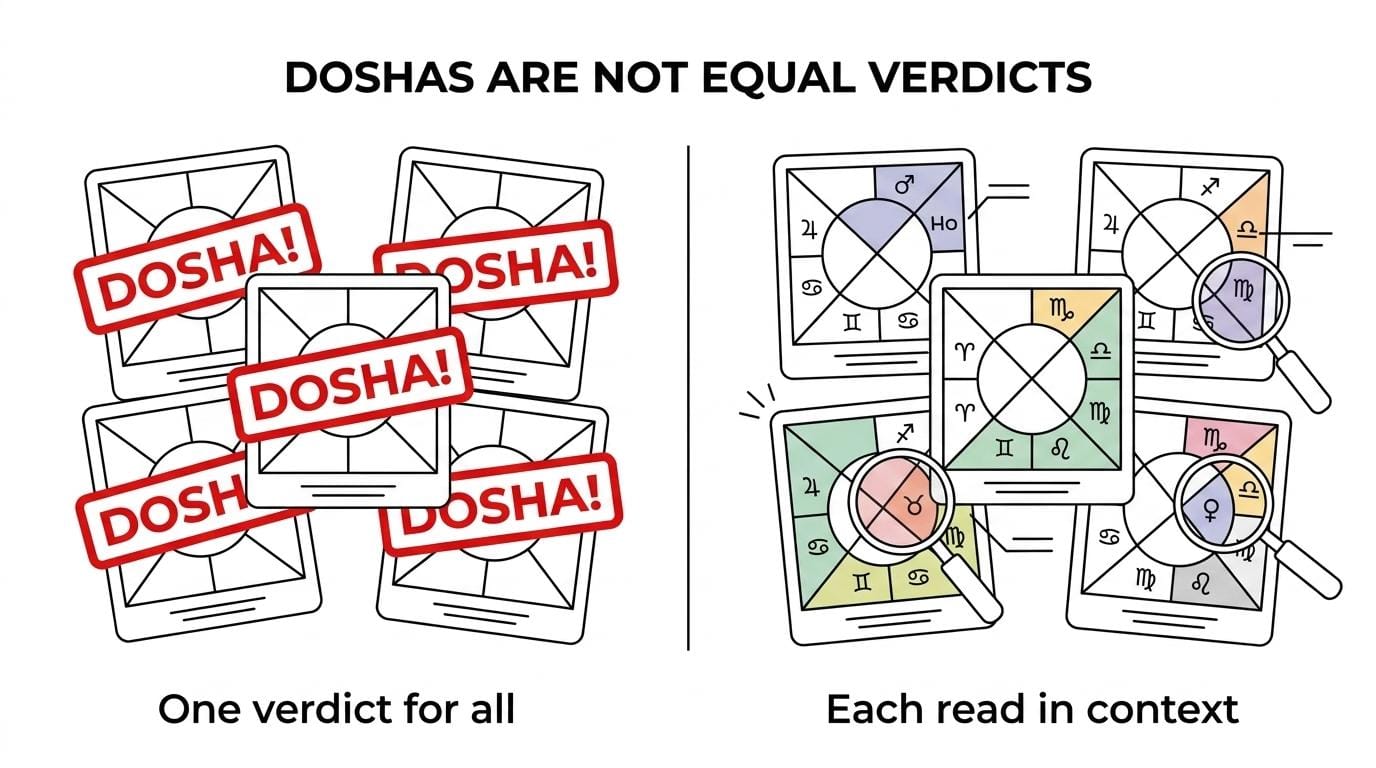
The five fears people ask about most often are Mangal Dosha, Sade Sati, Kaal Sarp Dosha, gemstone mistakes, and Nadi Dosha in marriage matching. These are not all the same type of thing, and the difference between them matters because people often react to them as if they're equal verdicts. They aren't.
Why these fears get exaggerated
A careful reading checks the planet from Lagna, Moon, and Venus. It looks at aspects, sign dignity, Navamsha confirmation, and whether the dasha currently running activates that part of the chart at all. Most fear-based readings check one or two of those, then deliver the verdict on a fragment of the chart rather than the whole of it.
The rest of this piece walks through what each of the five actually shows, and what to ask before you accept the label.
What the five doshas are, and what people get told instead
Side-by-side comparison of common feared doshas, the fear people hear, and the more accurate chart-based interpretation. Mangal Dosha is a placement-based marital concern linked to Mars. Sade Sati is a Saturn transit from the Moon. Kaal Sarp is a nodal enclosure pattern. Gemstone anxiety is remedial anxiety. Nadi Dosha belongs to Ashtakoot matching through nakshatras.
That difference matters because people often compare them as if they are all equal verdicts. They are not.
Feared concept | Technical definition | What people often hear | Better way to read it |
|---|---|---|---|
Mangal Dosha | Mars placed in marriage-sensitive houses (1st, 4th, 7th, 8th, 12th, sometimes 2nd) | "No one will marry me. My husband will die young." | Check Mars from Lagna, Moon, and Venus. Read the 7th house, 7th lord, Venus, and Navamsha. Match both charts. |
Sade Sati | Saturn transiting 12th, 1st, and 2nd from natal Moon | "Everything in my life will fall apart for 7.5 years." | Read Saturn with the Moon's strength, Saturn's house rulership from Lagna, and the running Mahadasha and Antardasha. |
Kaal Sarp Dosha | All seven classical planets enclosed between Rahu and Ketu | "I'm karmically cursed. My life is blocked and nothing will ever work." | Verify the exact rule being used, because definitions vary by school. Then read what Rahu, Ketu, and their dispositors are doing. |
Gemstone fear | Concern about strengthening the wrong planet through a stone | “One wrong stone can ruin everything” | A gem is a directional remedy tied to chart logic. What it amplifies depends on which planet it's tied to and what role that planet plays in your chart. |
Nadi Dosha | Same Nadi in Ashtakoot matching by nakshatra | "We can never marry. Our marriage will fail." | Check cancellation rules first. Then read the full marriage chart, not just the matching score. |
That right-hand column is the difference between reading a chart and reacting to a label.
Is Mangal Dosha bad? Am I Manglik, and is it bad?
Mangal Dosha refers to Mars sitting in houses tied to self, home, marriage, intimacy, or bed comforts. The popular rule flags Mars in the 1st, 4th, 7th, 8th, or 12th house. Some schools include the 2nd. The reasoning is straightforward: an intense, unsupported Mars can bring heat, impatience, or conflict into relationship life.
But Mars is never read alone. Classical Jyotish weighs sign dignity, aspects from Jupiter or benefics, the 7th house and 7th lord, Venus, the Navamsha, and whether the partner's chart carries a similar intensity. Many "Manglik" charts also carry a strong Venus, a stable 7th lord, or Jupiter's protection — and in those charts, Mars often shows up as courage and directness rather than as friction.
Here's what most people aren't told: the Manglik rule itself varies by school. Mars from Lagna only, or also from Moon and Venus? The five-house version, or the six-house version that includes the 2nd? Different astrologers running the same chart will produce different verdicts on whether you're Manglik at all. Before you accept the label, ask which framework produced it. You may not be Manglik in the rule that actually applies to your reading.
“Being Manglik is not a verdict on marriage. It is a sign that Mars needs to be read carefully, not feared automatically.”
If you are asking, “Am I manglik, is it bad?” the real question is whether Mars is unsupported and whether the marriage axis is already under strain. A fuller breakdown is available in this Manglik guide.
What happens if you have Sade Sati? Is Sade Sati really 7.5 years of bad luck?
Sade Sati is Saturn’s transit through the 12th, 1st, and 2nd signs from the natal Moon. Because Saturn spends about 2.5 years in each sign, the total period is roughly 7.5 years. The core idea is not “Saturn destroys everything.” It is that Saturn puts pressure on the Moon, which represents mind, emotional comfort, memory, and habit.
What the effects are, though, is a question of framing. Saturn pressures the Moon, which represents mind, emotional comfort, memory, and habit. The popular version of Sade Sati treats that pressure as punishment. The classical version treats it as maturation. Same transit, different reading.
"Saturn asks the Moon to grow up."
Here's how we read each phase:
12th from Moon is about releasing what was quietly draining you. The sleep that wasn't restful, the expenses that weren't choices, the attachments that were costing more than they returned. Saturn doesn't take these away to punish you. It takes them away because you weren't going to put them down on your own.
Over the Moon is identity restructuring from the inside. Borrowed self-image gets replaced with something earned. People often experience this as heaviness because the old version of themselves is dissolving faster than the new one is forming. The discomfort is the gap between the two, not Saturn's malice.
2nd from Moon is discipline with what comes out of your mouth and what stays in your account. Speech, savings, family responsibility. Saturn here is asking whether you can hold form under pressure — and the answer becomes the foundation for the decade that follows.
How intense any of this feels depends on natal Saturn, the Moon's strength, Saturn's house rulership from your Lagna, and the dasha running underneath. Sade Sati during a Jupiter Mahadasha feels nothing like Sade Sati during a Saturn-Rahu period. The transit name alone tells you very little. The full reading tells you everything. If you want the longer version, StarYaar has a full guide on Sade Sati explained simply.
How to know if I have Kaal Sarp Dosha, and is Kaal Sarp Dosha dangerous?
Kaal Sarp Dosha is usually defined as all seven classical planets falling on one side of the Rahu-Ketu axis. That's the popular version. The problem is that astrologers don't agree on the rule. Some count planets conjunct Rahu or Ketu differently. Some allow a "partial" Kaal Sarp. Some exempt charts where the Lagna or a key planet breaks the enclosure. Two reputable astrologers can examine the same chart and reach opposite conclusions.
Kaal Sarp fear often grows faster than the actual yoga, because the definition itself changes from one astrologer to the next.
We'll be honest with you: Kaal Sarp doesn't appear as a named yoga in the foundational classical texts the way Mars-in-houses or Saturn transits do. It came into wide practice through later traditions and modern popularization, which is part of why the definition is still actively disputed. That doesn't make it meaningless — Rahu and Ketu enclosing the rest of the chart can describe real intensity, obsession, or uneven momentum. But "danger" is too blunt a word for a pattern whose definition is still actively debated within the tradition itself.
If a reading flagged you for Kaal Sarp, ask which rule was used. Then ask what Rahu, Ketu, and their dispositors are actually doing in the chart. That's where the real story is.
Do I really need to wear a gemstone?
A gemstone, in Jyotish, is a planetary remedy. Ruby strengthens the Sun, Pearl the Moon, Red Coral Mars, Emerald Mercury, Yellow Sapphire Jupiter, Diamond Venus, Blue Sapphire Saturn, Hessonite Rahu, Cat's Eye Ketu. A gem is not a generic lucky charm. It's a directional tool — you put it on because you want more of a specific planet's energy in your life.
This is exactly why casual prescription is the problem. If a stone is recommended without checking house lordship, dignity, current dasha, and whether the planet should be strengthened at all, the prescription is doing real work on shallow logic. The villain isn't the gem. It's the prescription practice.
When a stone is poorly chosen, the effect is directional. You amplify a planet that was already troubling parts of your chart, and you get more of what you didn't want — more heat from an unsupported Mars, more confusion from a difficult Mercury, more excess from a misplaced Venus. By the time you notice, you've often attributed the problem to something else entirely.
That's why proper chart logic matters more than the stone itself. A weak benefic planet may genuinely benefit from strengthening in some schools. A functionally difficult planet usually should not be amplified just because someone said so at a gem shop. And often, the right remedy isn't a gem at all — mantra, daan, fasting, prayer, disciplined action, or careful timing work just as well, sometimes better, and they cost nothing.
A gem is only as good as the chart logic behind it. If no one has shown you that logic, you don't have a prescription. You have a guess.
Is Nadi Dosha a problem for marriage? Can marriage happen with Nadi Dosha?
Nadi Dosha belongs to Ashtakoot matching, the traditional guna milan framework used in marriage compatibility. It's calculated from nakshatras, not houses. Each birth nakshatra falls into one of three Nadis — Adi, Madhya, or Antya — and a match between two people of the same Nadi is flagged as Nadi Dosha.
The reason it scares people is that Nadi carries the highest weight in the matching score — 8 points out of 36, more than any other koota. The reason that scare is overstated is that classical cancellation rules apply more often than people realize. The dosha is traditionally considered cancelled when both partners share the same nakshatra entirely, when they share the same Rashi but different nakshatras, or in some traditions when their nakshatra padas differ. A large portion of apparent Nadi Dosha cases fall into one of these cancellation conditions.
And even where the dosha holds, Ashtakoot is one input not the whole marriage chart. The 7th house, 7th lord, Venus, Jupiter, Navamsha, Mangal factors, and dasha timing all matter at least as much. A matching score is not a marriage verdict. Treat it as one signal among many, and read it against the rest of both charts before drawing any conclusion.
Quick answers to common dosha questions
Is manglik dosha bad for everyone?
No. An unsupported Mars can show friction. A supported one often shows courage and clarity. The rest of the chart decides which.
Is Sade Sati always painful?
No. It's usually demanding, but many people use it to build discipline and emotional maturity. Natal Saturn and the running dasha shift the experience significantly.
Is Kaal Sarp Dosha always real if one website says so?
Not necessarily. The rule varies by school and software. Verify the definition before reacting.
Do gemstones always work the same way?
No. They are specific planetary remedies and should not be prescribed without chart logic.
Can marriage happen with Nadi Dosha or Manglik mismatch?
Yes, often. Both need full chart judgment. Many marriages proceed well when broader compatibility is strong and the feared label is mild or canceled.
How a reliable dosha reading is actually done
A dosha is a pressure point in your chart, not a sentence passed on your life. The fear you may be carrying came from a reading that named the pressure without showing you what it actually means, what supports it, what offsets it, and what the timing looks like.
In Vedic astrology software, three technical choices matter more than most people realize: birth time accuracy, ayanamsha choice, and the calculation engine. A trustworthy system should be transparent about whether it uses Lahiri or another ayanamsha, whether it checks doshas from Lagna only or also Moon and Venus, and how it weighs Navamsha, yogas, and dasha activation. StarYaar charts are built with Swiss Ephemeris precision, which is a good example of the kind of calculation transparency people should expect from any platform.
The healthiest way to read these feared patterns is simple: treat them as maps of pressure, not verdicts on your future. A map helps you see where Mars needs patience, where Saturn asks for structure, where Rahu-Ketu intensity needs grounding, where remedies need logic, and where marriage matching needs more than one score. That is still real astrology. It is just astrology read with clarity instead of fear.